Showing posts with label Sermon on the Mount. Show all posts

Monday, September 28, 2020

Sloth Versus Those Who Mourn

 Here is my message from Sunday. The text was John 11:17-27, 32-44:

Just a little over two year ago, the bookkeeper at the church I was serving literally dropped dead one morning. He was sitting on the couch reading and his wife walked into their bedroom to grab something, and when she came out a few minutes later Don was on the floor without a pulse. It was one of those reminders of the fragility of life. But we had already had a reminder of that at the church because just a few months before that, the head of our praise band came down with the flu, which rapidly turned into double pneumonia, and four days later she died. And then on top of that, two weeks after Don died, Elizabeth was born, and she spent the first four days of her life in the NICU and came home on continuous oxygen. I think I definitely could have managed one of these events in my life, and perhaps two of them, but three were just too taxing to me in every way possible. And so while I was still working, I was only focusing on what I considered the most important things, trying to take care of the fires, and everything else fell to the side.

We didn’t buy pumpkins that year, and I spent Halloween day trying to find some for the girls to carve, which we couldn’t find. and those of you who saw the parsonage last year lit up with Christmas lights now how much I love Christmas, but I didn’t put up a single light that year. We did get a Christmas tree, and to be honest, if we didn’t have children, I doubt we would have even done that. The grief and exhaustion were just too much; and as much as people wanted me or needed me to do things, I just couldn’t get anything done. I know that many of you have been in a similar space after a loss. The mourning and the grief are just too much to be able to live as normal. And in fact in some cases we just shut down. And so as we are thinking about the Beatitudes and the seven deadly sins,  and looking at Jesus’ blessing of those who mourn  it seemed natural to link it with sloth because they seem to have similar behaviors. But they are not the same.

Monday, September 21, 2020

Pride Versus the Poor in Spirit and the Meek

 Here is my sermon from Sunday. The text was Luke 18:9-14:

In Star Wars, Luke Skywalker is shown two different ways to live. He can live with the force, and we might say live in the light, or he can choose the dark side, and he has two masters, Obi Wan Kenobi and Darth Vader, showing him their particular way and seeking to get him to follow, even enticing him or telling him that it is his destiny. But it is up to Luke to decide which he is going to choose, while also seeing that choosing one over the other does not necessarily mean its forever, as best demonstrated by Darth Vader who first chooses the dark side, but, 40 year-old spoiler alert, is later redeemed and saved and brought back into the light. Two ways of living in the world, and two ways that are opposite of each other and lead to radically different ways of living and two different results. 

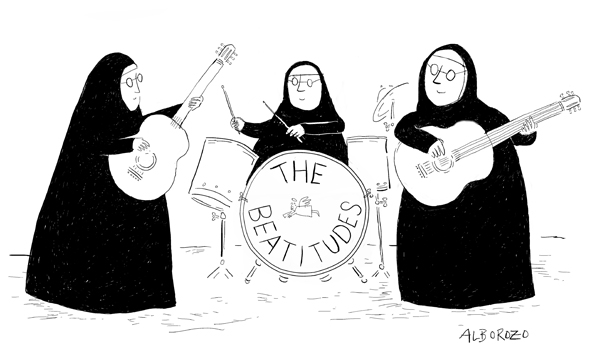
I thought that was an appropriate analogy for us today as we begin a new worship series in which we are going to be looking at the seven deadly sins and comparing them against the Beatitudes, which are two different ways of living, as I said in the worship intro on Friday, it’s sort of comparing the ways of the world against the ways of the Kingdom of God, and we do indeed get to choose which to follow. Or another way to think of it as we drop into the final weeks of the political campaigns is that they are two different platforms being presented to us to for us to choose who we will follow and which way we would like to see the world run. Now this idea came from a book entitled Seven by Jeff Cook, in which he compares the Beatitudes and the Seven Deadly Sins, which I first read several years ago and so he deserves the credit for the idea. I don’t follow his set-up of comparisons, and I’ve seen others who have done the same sense, and so whether they took his idea and did it as well, or it was done before, I don’t know, but he did inspire me.

Monday, September 19, 2016

Pride Versus The Meek

Here is my sermon from Sunday. The texts were Matthew 5:1-12 and 7:12-23:

“I am an invisible man….” Thus begins Ralph Ellison’s classic Invisible Man.  “I am a man of substance, of flesh and bone, fiber and liquid, -- and I might even be said to possess a mind,” Ellison says, but, he continues, “I am invisible, understand, simply because people refuse to see me.” I am invisible because people refuse to see me. I thought that was an appropriate way, or the appropriate sentiment, to begin today’s sermon as we continue in our series on the seven deadly sins and the beatitudes and tackle the deadly sin of pride, the way of the world, against the way of the Kingdom of God, as contained in the beatitudes and the sermon on the mount with those who are poor in spirit and those who are meek, the people we might never see, or refuse to see, and certainly the people society says we shouldn’t pay any attention to not only because they are not worth or time, but even more because they are simply unworthy. They are losers.  Our society values the rich, the educated, the famous, those who are athletically gifted, the powerful, those whose who are physically beautiful. The meek, the poor, they deserve whatever they get, and should be happy to receive anything at all, even our disdain. They should be grateful we don’t truly act as if they are invisible.  If they don’t have enough pride to assert themselves, then there is nothing we should do for them. Losers.

But, Jesus says, while that might be the way the world would like to operate, it’s not the way it’s supposed to be, it’s not the way of God, it’s not the way of the Kingdom of God. God calls for something different, and God rewards something different. So Jesus says, as we heard last week, blessed are the peacemakers, for they shall be called what? Children of God, and if you missed last week’s message I would encourage you to watch it online.  And blessed are the poor in spirit, for theirs is the kingdom of heaven, and blessed are the meek for they will inherit the earth. That again turns the world on its head, for how it’s not just that the meek and the poor in spirit are blessed, and we’ll come back next week to what it means to be blessed, but theirs is the kingdom of heaven. It’s theirs now in the present tense. Don’t confuse Matthew’s usage of the term heaven here with the afterlife. That is not what Matthew is referring to, and so if you need to hear something different to get away from the afterlife connotation, you can place in the term Kingdom of God here, which is the term that both Mark and Luke use consistently. That’s what the poor in spirit get, and what do they meek get, they shall inherit the earth. The whole earth, not some small part of it, not the part they have marked out hiding behind some pole because they are meek, but the whole earth, as an inheritance. Why do you inherit something? Because you are related, which means that God is claiming the meek as God’s own, as children, as heirs to inherit what God has to give. The meek. As they say in Monty Python's Life of Brian, "That's nice, I'm glad they're getting something, 'cause they have a [heck] of a time."

Monday, September 12, 2016

Wrath Versus Peacemakers

Here is my sermon from Sunday. The texts were Matthew 5:1-12 and 5:38-48:

Most of us probably remember where we were and what we were doing 15 years ago today. We remember the moment when we first heard about a plane, or planes hitting the world trade center, we remember seeing people fleeing from the buildings, and seeing the fire department running towards the buildings. We remember the buildings collapsing and our tears and our sorrow and our questions and maybe our fears. Some watched from a distance not knowing anyone involved, and others had their lives ripped apart that day.  When we lived in Boston, Linda and I were friends with a woman who had a plane ticket for one of those flights, but her meeting in LA got cancelled, and so she never got on board, and in both churches we served there, literally right around the corner from both of them was a memorial to the people in those towns who had lost their lives on that day. and yet in the devastation of that moment we experienced something special, something unique. We witnessed bravery and heroism most of us had only heard about. We witnessed sacrifice and selflessness. We witnessed a nation, and to a large degree a world, coming together, not based on national or tribal affinities, but based on a shared and common humanity.

Jesus said that “No one has greater love than this, to lay down one’s life for one’s friends.” And so, someone said that in witnessing the firefighters and the police officers running into a burning building while everyone else was running out, laying down their lives for their friends in the greatest sense of that word, we glimpsed the kingdom of God. Of course that glimpse did not last long, and we soon turned away from the things that brought us together, and instead started building up barriers and walls, shouting tribal chants and seeking revenge and war. A war that continues to this day, so that this year’s entering college freshmen can never remember a time in which we as a nation were not at war. But for a moment, in the midst of the chaos and violence and tragedy, we witnessed the kingdom of God.

One of the responses I received about what people would like me to preach on was to talk about the election and how we as Christians should be thinking about and responding to what is happening. With disgust might be one response, but probably not the appropriate one. I do think it’s appropriate that we talk about the election, but how I was going to do that was the issue. I do know that there are some people who get upset and think that politics should never be talked about it in church, but that’s actually an impossibility. Because to proclaim Jesus as Lord and King, is to make a political statement; it’s to claim where our allegiance belongs, to God, and also where it doesn’t belong, to the things of the world. In addition, Jesus had a lot to say about things that are impacted by what we would call the political realm. So if we are to proclaim ourselves as Christians, as followers of Christ, that is political.

Wednesday, February 12, 2014

This Little Light of Mine

Here is my sermon from Sunday.  The text was Matthew 5:13-20:

When the Puritans first arrived in America, they saw themselves acting out the exodus story, with America as the new Promised Land.  John Winthrop, one of the early governors of the Massachusetts Bay Colony, referred to the colony as “the city on the hill” which would be a beacon to the rest of the world of what Christianity, when rightfully practiced and purified of Catholicism, hence the name Puritans, would look like.  When they were choosing the location for a new state house, they choose the tallest hill in Boston, called Beacon Hill, and had the dome of the building clad in copper by none other than Paul Revere, so that it would reflect the sunlight and be seen as the light on the hill.  This idea of being the city on the hill has been a recurrent theme in American politics and American religion, and it is found not just here in today’s passage from the Sermon on the Mount, but is part of Jewish tradition as well.

In Isaiah, God says, “I am the Lord, I have called you in righteousness, I have taken you by the hand and kept you; I have given you as a covenant to the people, a light to the nations, to open the eyes that are blind, to bring out the prisoners from the dungeon, from the prison those who sit in darkness.” (42:6-7) As part of the covenant between Israel and God, God has set them up as a light to the nations.  Of course part of that covenantal also involved salt, as we are told in Leviticus in the instructions given regarding offerings, that salt was to be given with every offering, and in the instructions given to Aaron, Moses’ brother about what offerings he and the other priests are to receive, they are told that they are to receive what the Lord gives them that it “is a covenant of salt forever before the Lord for you and your descendants.”

Salt played a critical role in the ancient world.  Roman soldiers were paid in salt, and as a remnant of that practice our word salary comes from the root word for salt.  To indicate fellowship or friendship it would be said that you had shared salt with someone.  It sounds sort of dirty doesn’t it?  But what it meant was that you had dined together, and were willing to share salt with that person, and since salt was valuable that indicated that you had a relationship that was more than just mere acquaintance.

Tuesday, February 4, 2014

Between A Rock And A Hard Place

Here is my sermon from Sunday.  The text was Matthew 5:1-12:

Who does society say is blessed?  Wealthy?  Educated?  Those on the East? Athletes? Actors? Entertainers? White?  Men?  Powerful? Politicians?  These are who society says are blessed, and it is certainly the groups that seem to have blessings showered on them.  In addition, there are those who will claim that these blessed people have these characteristics because they are blessed by God, and because they are blessed by God they also have these characteristics.  It’s a circular argument.  But although that is who society is blessed, that is not who Jesus says is blessed, which is what we hear today in the gospel passage from Matthew:

zouchmagazine.com
When Jesus saw the crowds, he went up the mountain; and after he sat down, his disciples came to him. Then he began to speak, and taught them, saying:

 ‘Blessed are the poor in spirit, for theirs is the kingdom of heaven.
 ‘Blessed are those who mourn, for they will be comforted.
 ‘Blessed are the meek, for they will inherit the earth.
 ‘Blessed are those who hunger and thirst for righteousness, for they will be filled.
 ‘Blessed are the merciful, for they will receive mercy.
 ‘Blessed are the pure in heart, for they will see God.
 ‘Blessed are the peacemakers, for they will be called children of God.
 ‘Blessed are those who are persecuted for righteousness’ sake, for theirs is the kingdom of heaven.
 ‘Blessed are you when people revile you and persecute you and utter all kinds of evil against you falsely on my account. Rejoice and be glad, for your reward is great in heaven, for in the same way they persecuted the prophets who were before you.