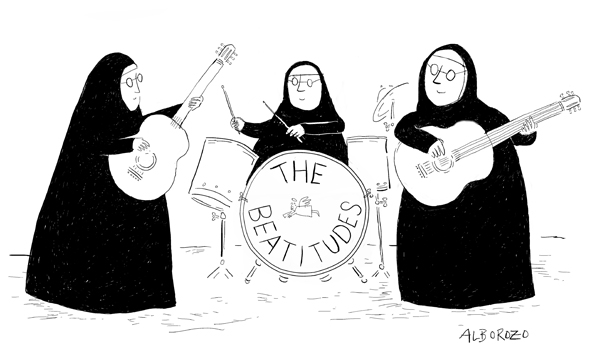
Earlier in this worship series we heard the parable of the Pharisee and the tax collector praying at the temple, and the Pharisees prayer of thanksgiving to God for not making him like the sinners there, especially like the tax collector. And so his prayer became one of self-righteousness, rather than true thanksgiving, because he felt superior to others, but only because he was spending his time looking at everyone else and comparing himself to others, rather than being focused on his prayer. Envy does the same thing to us. Envy is a sin of looking around and seeing others and making destructive comparisons either because we judge ourselves less than, or others less than. And so remembering that the seven deadly sins were compiled in monasteries, where, for the most part everyone was exactly the same, and wore the same clothing, and ate the same things, any little change that could cause envy could destroy the community that had been established. And as Joseph Epstein said, of all the deadly sins, only the sin of envy is no fun, and it is the only one that is always directed at someone else, which is not true of the others, because even lust can be directed at an inanimate object.
Monday, November 2, 2020
Envy Versus Persecution
Monday, October 26, 2020
Wrath Versus Peacemakers
Here is my message from Sunday. The text was Matthew 5:38-48:
One of my favorite movie characters comes from the movie Inside Out and it’s the character of Anger, voiced by the inestimable Lewis Black. For those unfamiliar with the movie, most of it takes place inside the head of a 12-year-old girl, and features the emotions of joy, sadness, disgust, fear and anger as they sort of battle for their spots in how Riley lives her life. And so anger plays a role as one of her natural emotions, and really has some of the best lines in the whole film, including after Riley and her mother receive pizza with broccoli on it, saying “Congratulations San Francisco, you ruined pizza. First the Hawaiians and now you.” Although I actually like Hawaiian pizza. But, as it turns out that even though Joy is trying to deny sadness a place in Riley’s life, she can’t because sadness belongs, just like anger belongs as a primary emotion.
And so as we think about anger, we have to understand that there is a natural place for anger in our lives, it’s just a matter of what that place is, and why we are angry. After all, we are even told that God “is slow to anger and abounding in steadfast love.” So God gets angry, and when God is angry it’s normally because of injustice or violation of the commandment to love. We even see Jesus getting angry, thinking of him turning over the tables of the money changers is probably the most prominent of them, but would anyone describe Jesus as being an angry person? No, just as when we talked about gluttony we said that while that was an accusation made of him, it would not be how we would describe him.
Monday, October 19, 2020
Lust Versus Pure in Heart
Here is my message from Sunday. The text was Matthew 5:27-30:
After receiving the law from God on Mount Sinai, Moses came down from the mountain and said to the people, “I’ve got some good news and some bad news. The good news is that I talked God down and there are now only 10 commandments. The bad news is that adultery is still one of them.” I’ve heard that joke from several clergy over the years, but the one that most surprised me was when conservative theologian and Anglican Bishop NT Wright told it. But I thought it perhaps maybe appropriate for today’s message when we talk about the sin of lust, which is one of the seven deadly sins, and compare it against Jesus telling us that those who are pure in heart are blessed.
Now if you were to just listen to what seems to be
emphasized in church, or talked to secular society about what the church
emphasizes as the primary sin, it would probably revolve around sexual
morality. And yet, Jesus has very little to say about it, especially when
compared to other things, like money. Indeed, Jesu eats with prostitutes and
says that they will enter the Kingdom of God before the more religious folks.
Now it’s not because there aren’t sinful attributes, but because of their
desire for salvation not being self-righteous. They know that they have fallen
short of the glory of God, and know they need God’s grace in their lives, and
so are seeking it out, and Jesus too is seeking them out as lost sheep. But,
what we also have to know about sexual morality in the church is that our understanding
of, and conversation about, sexuality is extremely narrow. We rarely, if ever,
talk about celibacy, for example, even though that was the preferred
arrangement in the early church, or at least according to Paul. But it’s
completely ignored today.
The other thing to keep in mind is that much of the church’s position about sexuality is not really scriptural, but instead comes to us from St. Augustine, who, to put it politely, had trouble controlling his own urges, his own lust, and so therefore felt that everyone needed to be controlled. Indeed, he even once prayed to God, “Grant me chastity and continence, just not yet.” And the final piece to keep in mind is that nearly all of the moralists over time have been men, and so their views about sex and sexuality have been limited, but have been applied to both men and women, and they harbor many of their fears about women, and we can even see that in the rules surrounding adultery that Jesus addresses in today’s gospel passage. But before we dig a little deeper into that, we need to step back a little bit to look at lust itself.
Monday, October 12, 2020
Greed Versus Mercy
Here is my message from Sunday. The text was Luke 16:19-31:
“Ladies and gentleman, greed -- for lack of a better word -- is good. Greed is right. Greed works. Greed clarifies, cuts through, and captures the essence of the evolutionary spirit. Greed, in all of its forms -- greed for life, for money, for love, knowledge -- has marked the upward surge of mankind. And greed -- you mark my words -- will not only save Teldar Paper, but that other malfunctioning corporation called the USA.” Most of you probably recognize that speech by Michael Douglas from the 1987 movie Wall Street. What might be less known is that the speech was not really the creation of the screen writer of the film, but instead came from the person on whom Douglas’ character was based, Ivan Boesky. Speaking at the graduation ceremony for the business school at the University of California at Berkley, Boesky said, “Greed is alright, by the way. I want you to know that. I think greed is healthy. You can be greedy and still feel good about yourself.” That was just a few months before he would be arrested by the SEC for insider trading to which he would plead guilty to one charge and pay a then record individual fine of $100 million. But before all that happened, he turned against his former compatriots and while collecting information against them for the SEC was allowed to continue doing insider trading making millions in profits until the SEC had enough information to also indict Michael Milken who was then forced to pay what is still the record individual penalty of $600 million. In response to the actions of wall street in the 80’s, congress passed a law that called for life in prison for certain financial crimes, and if you are wondering how many bankers or wall street execs have been subject to that penalty, the answer is less than one. What other studies have also found is that the average sentences for financial crimes are half those of other federal crimes. Who says that crime doesn’t pay, and that greed is not good?
And so today we look at the deadly sin of greed. In some of the other seven deadly sins we have looked at, we have talked about different types of sins, or several sins that have been grouped into one idea, but that’s not the case here. Greed is greed, and of the deadly sins this is probably the one that has the most indoctrination and support from the general culture. And of course you can be greedy for lots of things, power, possessions, accomplishments, conquests, but the thing we most often hear about greed surrounds money. And while we often talk about rich people being greedy, greed itself is not dependent upon the amount of money that we actually have. You can be greedy and only have a dollar to your name, and you can be greedy with a million dollars in the bank; the same way as you can be generous as a millionaire and generous with only a dollar, as the widow was with her two mites contributing all she had to the Temple. Money is value neutral, as we heard in that passage from 1 Timothy, which is often misquoted as saying that money is the root of all evil, it actually says that the love of money is the root of all kinds of evil. Therefore, greed is about an attitude of the heart, and most often plays itself off at the expense of others who are around them, with a total lack of care for them. which is why greed made the list of the seven deadly sins because remember that they came out of the earliest monastic communities, and these sins were considered to be the things that would destroy community, and so it’s how greed plays itself out in community, in relationship with others, that makes it so problematic.
Monday, October 5, 2020
Gluttony Versus Those Who Hunger and Thirst for Righteousness
Here is my message from Sunday. The text was Matthew 6:25-34:
One of the accusations that was leveled against Jesus, both by opponents, and even somewhat by supporters was that he was a glutton. This accusation was especially true when compared against John the Baptist. We are told that John was living an ascetic lifestyle wearing a camelhair cloak, which wasn’t very comfortable, and that he ate locusts with wild honey. I’m thinking the honey was a dipping sauce. That is a very different picture than what we see of Jesus, and in fact John’s disciples come and ask why it is that they are fasting while Jesus and the disciples are not. To which Jesus says that someday they will fast, but they should feast while the bridegroom is still with them. The accusation that Jesus was a glutton was a slur used against him to try and denigrate him and his message, more than a reality. But, it does appear that it was fun to be around Jesus, at least most of the time, and as I said in this week’s newsletter, we have lots of stories of Jesus eating with the disciples and with others.
Eating, breaking bread, was important to Jesus and a part of his witness about the Kingdom of God, and we still talk about the feasting that Jesus is preparing for us, and yet what we see in that is the judgments about his behavior could be made. We still see that today because of the seven deadly sins, the one that many people feel comfortable making a judgment about, especially when it comes to others, is the sin of gluttony. Most people just assume that people are overweight because they are gluttonous, and while gluttony does have something to do with overeating, it doesn’t really have anything to do with obesity. The two are not necessarily connected. You can be gluttonous and skinny. And we have to remember that when it was the poor who were skinny that having a little meat on your bones was said to represent divine favor, virtue and nobility. Oh how things change.
Monday, September 28, 2020
Sloth Versus Those Who Mourn
Here is my message from Sunday. The text was John 11:17-27, 32-44:
Just a little over two year ago, the bookkeeper at the church I was serving literally dropped dead one morning. He was sitting on the couch reading and his wife walked into their bedroom to grab something, and when she came out a few minutes later Don was on the floor without a pulse. It was one of those reminders of the fragility of life. But we had already had a reminder of that at the church because just a few months before that, the head of our praise band came down with the flu, which rapidly turned into double pneumonia, and four days later she died. And then on top of that, two weeks after Don died, Elizabeth was born, and she spent the first four days of her life in the NICU and came home on continuous oxygen. I think I definitely could have managed one of these events in my life, and perhaps two of them, but three were just too taxing to me in every way possible. And so while I was still working, I was only focusing on what I considered the most important things, trying to take care of the fires, and everything else fell to the side.
We didn’t buy pumpkins that year, and I spent Halloween day trying to find some for the girls to carve, which we couldn’t find. and those of you who saw the parsonage last year lit up with Christmas lights now how much I love Christmas, but I didn’t put up a single light that year. We did get a Christmas tree, and to be honest, if we didn’t have children, I doubt we would have even done that. The grief and exhaustion were just too much; and as much as people wanted me or needed me to do things, I just couldn’t get anything done. I know that many of you have been in a similar space after a loss. The mourning and the grief are just too much to be able to live as normal. And in fact in some cases we just shut down. And so as we are thinking about the Beatitudes and the seven deadly sins, and looking at Jesus’ blessing of those who mourn it seemed natural to link it with sloth because they seem to have similar behaviors. But they are not the same.
Monday, September 21, 2020
Pride Versus the Poor in Spirit and the Meek
Here is my sermon from Sunday. The text was Luke 18:9-14:
In Star Wars, Luke Skywalker is shown two different ways to live. He can live with the force, and we might say live in the light, or he can choose the dark side, and he has two masters, Obi Wan Kenobi and Darth Vader, showing him their particular way and seeking to get him to follow, even enticing him or telling him that it is his destiny. But it is up to Luke to decide which he is going to choose, while also seeing that choosing one over the other does not necessarily mean its forever, as best demonstrated by Darth Vader who first chooses the dark side, but, 40 year-old spoiler alert, is later redeemed and saved and brought back into the light. Two ways of living in the world, and two ways that are opposite of each other and lead to radically different ways of living and two different results.
I thought that was an appropriate analogy for us today as we begin a new worship series in which we are going to be looking at the seven deadly sins and comparing them against the Beatitudes, which are two different ways of living, as I said in the worship intro on Friday, it’s sort of comparing the ways of the world against the ways of the Kingdom of God, and we do indeed get to choose which to follow. Or another way to think of it as we drop into the final weeks of the political campaigns is that they are two different platforms being presented to us to for us to choose who we will follow and which way we would like to see the world run. Now this idea came from a book entitled Seven by Jeff Cook, in which he compares the Beatitudes and the Seven Deadly Sins, which I first read several years ago and so he deserves the credit for the idea. I don’t follow his set-up of comparisons, and I’ve seen others who have done the same sense, and so whether they took his idea and did it as well, or it was done before, I don’t know, but he did inspire me.
Sunday, October 23, 2016
Envy Versus Persecuted
Magic trick… When I saw that trick done by an actual magician at the state fair, I immediately thought of this message and the idea of envy, because, honestly, I envied the fact that he could do the trick, and thought how cool would it be to be able to do that in front of you all and have you envy me, except that I can’t actually do the trick because I don’t know how to make the actual coke disappear. And so all I could do was to be envious. Envy can be useful, in that it can lead us to be better, then is my envy of the magician could lead me to actually go out and learn how to do those tricks to, and it’s been said that there is no ambition without a little bit of envy attached, but it can also be destructive. Destructive to ourselves and also destructive to others. And all of us have this sin of envy within us. All of us have been envious of someone else at least once in our lives, and this is a universal trait as I read this week that every known language in the world has a word approximating what we understand as envy. Envy lies at the root, or at the very least is a part, of many of the other deadly sins that we have spent the last six weeks looking at, and envy is unusual in several ways.
The first is that envy is always directed at someone else, which is not true of the others, because even lust can be directed at an inanimate object, rather than at a real person. The other thing about envy, according to Joseph Epstein, is that “Of the seven deadly sins, only envy is no fun at all.” Now one of the things that I’ve been surprised about in my reading for this series is that although the Seven Deadly Sins came out of the Christian monastic community, and were finalized and promulgated by Pope Gregory the Great, there are a lot of Jewish writers writing on the seven deadly sins. Epstein is also the one who coined the term virtucrat which he defines as "any man or woman who is certain that his or her political views are not merely correct but deeply, morally righteous in the bargain.” I think that fits well into the idea of how people often think about suffering, as well as envy, because I think the best definition for envy, and the reason I matched it up with Jesus statement that blessed are those who are persecuted for righteousness sake, is that envy is sadness at another person’s good fortune. While suffering leads us to ask the question “why me?” Envy leads us to ask “why not me?”
Monday, October 17, 2016
Lust Versus Pure In Heart
When Moses came down off the mountain with the Ten Commandments, he said to the Israelites, I have some good news and some bad news. The good news is I talked God down from 30 rules to only ten, and the people got really excited about that. But the bad news is, Moses said, that adultery is still one of them.
Perhaps, appropriately enough, today we continue in our series on the Seven Deadly Sins and the Beatitudes looking at the deadly sin of lust against Jesus’ statement that blessed are the pure in heart for they shall see God. When Donna, who is our office administrator, sawthis week’s topic she said to me, so after everything that happened last week, you’re going to be talking about lust? Who says that God doesn’t have a sense of humor? Maybe God does, or perhaps no matter when we were talking about this issue there would have been something taking place in the news that would point out not only the dangers of lust, but also the hypocrisy that we have when it comes down to the issues that surround lust. Because while we as Americans have tremendous hang-ups on the issues of sex and sexuality, we also simultaneously are surrounded by it. Not because it’s being pushed down our throats by uncaring advertisers and pop culture makers, but because they are doing that because it works and will either get them more sales or at least more eyeballs, and thus more money. Lust is a major part of our culture, because lust is about a lot more than just sex because we can lust for lots of different things.
Monday, October 10, 2016
Greed Versus Mercy
“Ladies and gentleman, greed -- for lack of a better word -- is good. Greed is right. Greed works. Greed clarifies, cuts through, and captures the essence of the evolutionary spirit. Greed, in all of its forms -- greed for life, for money, for love, knowledge -- has marked the upward surge of mankind. And greed -- you mark my words -- will not only save Teldar Paper, but that other malfunctioning corporation called the USA.” Most of you probably recognize that speech by Michael Douglas from the 1987 movie Wall Street. What might be less known is that the speech was not really the creation of the screen writer of the film, but instead came from the person on whom Douglas’ character was based, Ivan Boesky. Speaking at the graduation ceremony for the business school at the University of California at Berkley, Boesky said, “Greed is alright, by the way. I want you to know that. I think greed is healthy. You can be greedy and still feel good about yourself.” That was just a few months before he would be arrested by the SEC for insider trading to which he would plead guilty to one charge and pay a then record individual fine of $100 million. But before all that happened, he turned against his former compatriots and while collecting information against them for the SEC was allowed to continue doing insider trading making millions in profits until the SEC had enough information to also indict Michael Milken who was then forced to pay what is still the record individual penalty of $600 million. In response to the actions of wall street in the 80’s, congress passed a law that called for life in prison for certain financial crimes, and if you are wondering how many bankers or wall street execs have been subject to that penalty, the answer is less than one. Who says that crime doesn’t pay, and that greed is not good?
Or at least that’s what we’re told, and at the very least shown. Make as much money as you can, buy as much stuff as you can, exercise or gain as much power as you can. If you are rich, you are good. If you are poor, you are bad. And of course we all know that if we make lots of money and drive the right car and live in the right house and even drink the right beer then we’ll all be happy and will attract the most beautiful member of the opposite sex right? And if you can’t actually afford to live that lifestyle, it’s still all attainable, just buy it all on credit, because no one really knows how much money you’re worth and so if you can show how successful you are through how much stuff you have, how much gold you own, then surely you have to be successful because we do indeed judge people not on who they are, but how much they make and what they own, and unfortunately we judge ourselves the same way. We think our salaries, or lack thereof, are a reflection of who we are and what we are, and there is the crux of the problem of greed, the deadly sin we are looking at today in comparison to Jesus injunction that the merciful are blessed and that they will receive mercy.
Monday, October 3, 2016
Gluttony Versus Hungering and Thirsting For Righteousness
At the beginning of the Gospel according to Matthew, we are introduced to John the Baptist and are told that he wore a camel hair coat, which was not very comfortable, to say the least, and that his meals consisted of “locusts and wild honey.” I’m hoping that the honey makes the locusts a little more palatable, but I don’t really want to try it to find out. What these statements about John tell us is that he was living the lifestyle of an ascetic, or someone who denies themselves of any worldly pleasures in order to try and contain and control, or tame, the body. Around the third century, some Christians started moving out into the Egyptian desert to live solitary, ascetic lives, to replicate what John the Baptist had been doing, in the hope of dedicating their full lives to God, and to do that to cut everything out of their lives they thought was unnecessary, or distracting to them. And so like John the Baptist, they limited not only what they ate, but the amount they ate as well. Known as the desert fathers and mothers, they began what we now know as monastic communities. They were also the ones to talk about the sins that would become the seven deadly sins, which includes the sin of gluttony. It is also then little wonder that it is Pope Gregory the Great who does the final compilation of this list of sins and begins promoting them since he is the first pope to come out of the monastic community and thus had been steeped in their ideas, so that even while he was combining and eliminating different sins that he would leave in the sin of gluttony, the one sin that truly deals with ascetic lifestyles, or the lack thereof.
Now gluttony is probably the hardest of the sins that we will deal with, at least for me. In our new Wednesday’s with Wesley group this week we were talking about Wesley’s advice for Methodists, as well as his general rules, and we were talking about that there are some rules that it’s really easy to say we will follow, but they are the ones that we don’t have any problem with to start. But the rules that actually apply to the things we really do, or want to do, those are the ones we dismiss or say they don’t really apply anymore or we make excuses about why they don’t apply to us, or why we aren’t really violating them. I want to do that with gluttony, as I’m guessing most of you do as well, because whether we want to admit it we are all gluttons at one point or another, although we are much more likely to point out this sin for others.
Monday, September 26, 2016
Sloth Versus Mourning
Pulitzer Prize winning play write Wendy Wasserstein wrote a tongue-in-cheek account of a self-help book that could sweep the nation entitled Sloth: And How to Get It. It promoted sloth as being achievable in just five easy steps, and even used sloth as an acronym. The S is for sit instead of stand, L is for let yourself go, O is for open your mouth and let anything you like enter, T is for toil no more, and H is happiness is within me, I don’t have to work at it. Now the problem with a self-help book promoting sloth is multifold. The first is that anyone who wants to promote such an idea is probably too lazy to actually write it, and the second is that those who want to become more slothful are too lazy to go get the book and those who would actually leave their couches to purchase it are too self-actualized to ever truly become slothful, and thus a book on how to become a sloth is probably destined never to be written. And perhaps that’s all for the best since sloth is one of the deadly sins, which is why we are looking at it today in comparison to what we find in the beatitudes and that is Jesus’ statement that those who mourn are blessed.
From the earliest times that the seven deadly sins were being compiled and pronounced, they have been compared against the virtues that the church thought we should be pursuing, but the list of comparative virtues has changed around depending upon who was doing the expounding. And so as I was trying to put together my list of comparing and contrasting the beatitudes and these sins, which I was not the first to do, I had to figure which was going to go with which, and the hardest one was for those who mourn. I decided to put sloth together with mourning because in some sense they can be very similar, or at least the behaviors can be similar. That is people who are mourning are often depressed and don’t want to do anything, which can be seen as sloth, and yet it’s not, besides for the fact that Jesus tells us that those who mourn are actually blessed. Do you feel blessed when you mourn?
Monday, September 19, 2016
Pride Versus The Meek
“I am an invisible man….” Thus begins Ralph Ellison’s classic Invisible Man. “I am a man of substance, of flesh and bone, fiber and liquid, -- and I might even be said to possess a mind,” Ellison says, but, he continues, “I am invisible, understand, simply because people refuse to see me.” I am invisible because people refuse to see me. I thought that was an appropriate way, or the appropriate sentiment, to begin today’s sermon as we continue in our series on the seven deadly sins and the beatitudes and tackle the deadly sin of pride, the way of the world, against the way of the Kingdom of God, as contained in the beatitudes and the sermon on the mount with those who are poor in spirit and those who are meek, the people we might never see, or refuse to see, and certainly the people society says we shouldn’t pay any attention to not only because they are not worth or time, but even more because they are simply unworthy. They are losers. Our society values the rich, the educated, the famous, those who are athletically gifted, the powerful, those whose who are physically beautiful. The meek, the poor, they deserve whatever they get, and should be happy to receive anything at all, even our disdain. They should be grateful we don’t truly act as if they are invisible. If they don’t have enough pride to assert themselves, then there is nothing we should do for them. Losers.
But, Jesus says, while that might be the way the world would like to operate, it’s not the way it’s supposed to be, it’s not the way of God, it’s not the way of the Kingdom of God. God calls for something different, and God rewards something different. So Jesus says, as we heard last week, blessed are the peacemakers, for they shall be called what? Children of God, and if you missed last week’s message I would encourage you to watch it online. And blessed are the poor in spirit, for theirs is the kingdom of heaven, and blessed are the meek for they will inherit the earth. That again turns the world on its head, for how it’s not just that the meek and the poor in spirit are blessed, and we’ll come back next week to what it means to be blessed, but theirs is the kingdom of heaven. It’s theirs now in the present tense. Don’t confuse Matthew’s usage of the term heaven here with the afterlife. That is not what Matthew is referring to, and so if you need to hear something different to get away from the afterlife connotation, you can place in the term Kingdom of God here, which is the term that both Mark and Luke use consistently. That’s what the poor in spirit get, and what do they meek get, they shall inherit the earth. The whole earth, not some small part of it, not the part they have marked out hiding behind some pole because they are meek, but the whole earth, as an inheritance. Why do you inherit something? Because you are related, which means that God is claiming the meek as God’s own, as children, as heirs to inherit what God has to give. The meek. As they say in Monty Python's Life of Brian, "That's nice, I'm glad they're getting something, 'cause they have a [heck] of a time."
Monday, September 12, 2016
Wrath Versus Peacemakers
Most of us probably remember where we were and what we were doing 15 years ago today. We remember the moment when we first heard about a plane, or planes hitting the world trade center, we remember seeing people fleeing from the buildings, and seeing the fire department running towards the buildings. We remember the buildings collapsing and our tears and our sorrow and our questions and maybe our fears. Some watched from a distance not knowing anyone involved, and others had their lives ripped apart that day. When we lived in Boston, Linda and I were friends with a woman who had a plane ticket for one of those flights, but her meeting in LA got cancelled, and so she never got on board, and in both churches we served there, literally right around the corner from both of them was a memorial to the people in those towns who had lost their lives on that day. and yet in the devastation of that moment we experienced something special, something unique. We witnessed bravery and heroism most of us had only heard about. We witnessed sacrifice and selflessness. We witnessed a nation, and to a large degree a world, coming together, not based on national or tribal affinities, but based on a shared and common humanity.
Jesus said that “No one has greater love than this, to lay down one’s life for one’s friends.” And so, someone said that in witnessing the firefighters and the police officers running into a burning building while everyone else was running out, laying down their lives for their friends in the greatest sense of that word, we glimpsed the kingdom of God. Of course that glimpse did not last long, and we soon turned away from the things that brought us together, and instead started building up barriers and walls, shouting tribal chants and seeking revenge and war. A war that continues to this day, so that this year’s entering college freshmen can never remember a time in which we as a nation were not at war. But for a moment, in the midst of the chaos and violence and tragedy, we witnessed the kingdom of God.
One of the responses I received about what people would like me to preach on was to talk about the election and how we as Christians should be thinking about and responding to what is happening. With disgust might be one response, but probably not the appropriate one. I do think it’s appropriate that we talk about the election, but how I was going to do that was the issue. I do know that there are some people who get upset and think that politics should never be talked about it in church, but that’s actually an impossibility. Because to proclaim Jesus as Lord and King, is to make a political statement; it’s to claim where our allegiance belongs, to God, and also where it doesn’t belong, to the things of the world. In addition, Jesus had a lot to say about things that are impacted by what we would call the political realm. So if we are to proclaim ourselves as Christians, as followers of Christ, that is political.
Tuesday, February 4, 2014
Between A Rock And A Hard Place
Who does society say is blessed? Wealthy? Educated? Those on the East? Athletes? Actors? Entertainers? White? Men? Powerful? Politicians? These are who society says are blessed, and it is certainly the groups that seem to have blessings showered on them. In addition, there are those who will claim that these blessed people have these characteristics because they are blessed by God, and because they are blessed by God they also have these characteristics. It’s a circular argument. But although that is who society is blessed, that is not who Jesus says is blessed, which is what we hear today in the gospel passage from Matthew:
| zouchmagazine.com |