Showing posts with label Women. Show all posts

Monday, October 19, 2020

Lust Versus Pure in Heart

 Here is my message from Sunday. The text was Matthew 5:27-30:

After receiving the law from God on Mount Sinai, Moses came down from the mountain and said to the people, “I’ve got some good news and some bad news. The good news is that I talked God down and there are now only 10 commandments. The bad news is that adultery is still one of them.” I’ve heard that joke from several clergy over the years, but the one that most surprised me was when conservative theologian and Anglican Bishop NT Wright told it. But I thought it perhaps maybe appropriate for today’s message when we talk about the sin of lust, which is one of the seven deadly sins, and compare it against Jesus telling us that those who are pure in heart are blessed.

Now if you were to just listen to what seems to be emphasized in church, or talked to secular society about what the church emphasizes as the primary sin, it would probably revolve around sexual morality. And yet, Jesus has very little to say about it, especially when compared to other things, like money. Indeed, Jesu eats with prostitutes and says that they will enter the Kingdom of God before the more religious folks. Now it’s not because there aren’t sinful attributes, but because of their desire for salvation not being self-righteous. They know that they have fallen short of the glory of God, and know they need God’s grace in their lives, and so are seeking it out, and Jesus too is seeking them out as lost sheep. But, what we also have to know about sexual morality in the church is that our understanding of, and conversation about, sexuality is extremely narrow. We rarely, if ever, talk about celibacy, for example, even though that was the preferred arrangement in the early church, or at least according to Paul. But it’s completely ignored today.

The other thing to keep in mind is that much of the church’s position about sexuality is not really scriptural, but instead comes to us from St. Augustine, who, to put it politely, had trouble controlling his own urges, his own lust, and so therefore felt that everyone needed to be controlled. Indeed, he even once prayed to God, “Grant me chastity and continence, just not yet.” And the final piece to keep in mind is that nearly all of the moralists over time have been men, and so their views about sex and sexuality have been limited, but have been applied to both men and women, and they harbor many of their fears about women, and we can even see that in the rules surrounding adultery that Jesus addresses in today’s gospel passage. But before we dig a little deeper into that, we need to step back a little bit to look at lust itself.

Monday, June 15, 2020

In the Beginning... Again

Here is my sermon from yesterday. The text was Genesis 2:4b-25:

When we were last together, we heard the first creation story, starting with the familiar line “In the beginning,” and then continuing with God speaking things into existence. It is the story of creation in six days, and then God resting on the seventh. It has the form with which most of us are familiar, and yet in its telling, we were missing many of the pieces which we also expect to find in the creation story, like God forming adam out of the ground, and then forming Eve using a rib from Adam, and the garden and the tree of the knowledge of good and evil. And those are missing from that first creation story, because they are obviously not a part of it, because they are a part of the second creation story. Many people are surprised to discover not just that we have two creation stories, but they are so different from each other. But, what they show us was also very common in the ancient near-east. Egypt, for example, had several different creation stories, as did the Babylonians. They had different stories, because they had different purposes and reasons for telling the story, and each of them contains a fundamental truth that might not be about how creation was made, but the why and the who of creation. But before we dig into that, let’s clear up one piece of information.

If you notice, and hopefully you did, or you heard me point it out in the worship video we send out on Friday’s. Today’s passage does not begin at the beginning of chapter two, as we might expect it to, but instead it begins at verse four, and then not even at the start, but what is called verse 4b, because it’s the second line of the verse. In the original manuscripts of both the Hebrew Bible and the New Testament, there are no chapter and verse markings. Occasionally there would be a larger space of white in the text marking a transition, but that was the only breaks in the text. You could not cite chapter and verse, you would just read or say the passage out loud so that people would not what you were talking about. Chapters were not added until the 13th century when Robert Langston, who was the arch bishop of Canterbury, added them to the text. We have no idea why he made the decisions he did, and you will sometimes see, as we do here, that there were some very strange decisions made, and, quite frankly, he made some mistakes. But, Langston did not do verses, that didn’t come until the mid-16th century, when Robert Estienne, sometimes also called Robert Stephens, added verses, which also occasionally have some strange placement. There have been attempts to correct some of these problems, but they have failed.

Monday, September 25, 2017

Proverbs: A Woman Of Valor

Here is my sermon from Sunday. The passage was Proverbs 31:10-31:

Today we conclude our series on the book of Proverbs by looking at what has become known as the Proverbs 31 woman. When I began planning this series, I knew I was going to address this passage even though I didn’t know what else I was going to talk about. But, I wanted to address this, because it has become one of the most used, and in my opinion, most abused scriptural passages, at least for a portion of the church. In her wonderful book A Year of Biblical Womanhood, Rachel Held Evans says “In the [Fundamentalist] Christian subculture, there are three people a girl’s got to know about before she [hits puberty]: 1) Jesus. 2) Ronald Reagan, and 3) the Proverbs 31 woman… Wander into any Christian women’s conference and you will hear her name… [and] Visit a Christian bookstore, and you will find entire women’s sections devoted to books that extol her… [visit any] Christian College” and you will find guys wanting to date her and girls trying to be her.

Now, I do have to admit that I did change Rachel Held Evans quote a little because she didn’t originally use the term fundamentalist, but instead talked about the evangelical church, but I reject the cooption of that term. In the past few decades Fundamentalist Christians rejected the term fundamentalist because of the negative connotations that began to accumulate with that term, and instead started calling themselves evangelical, but we in the middle or progressive side of the church need to fight against the claiming of that word, because we too can and are evangelical, without being fundamentalists, but that’s just me on a personal tangent.

Tuesday, May 19, 2015

Mary of Magdala

Here is my sermon from Sunday.  The text was John 20:1-18:

As many of you know, it is said that the best-selling book of all time is the Bible.  The 13th best-selling book in any language is the Da Vinci Code by Dan Brown, which is also the tenth best-selling book in English.  So, it is perhaps not surprising that when I began asking people what women in the Bible I should preach on, nearly without exception, the first name that came up was Mary Magdalene.  Although people have had a fascination with Mary Magdalene for a long time, and within recent memory, she has played a significant role in Jesus Christ Superstar and in the novel and movie The Last Temptation of Christ and Mel Gibson’s The Passion it is The Da Vinci Code which has driven resurgence in interest and thinking about Mary.  But most of this has been more speculation and fiction, than reality.

Now I don’t have a very high opinion of Dan Brown.  I think he is a great suspense writer, and I have, in fact, read most of his books, but the problem is he includes facts that could be disproved with just two minutes on Wikipedia or ten minutes in the library, and then passes those off facts as the absolute truth, and this is especially true in The Da Vinci Code.  So for example, he says that the Dead Sea Scrolls were discovered in the 1950s and contained the earliest Christian writings, when in fact they were found in 1947 and do not contain any Christian writings at all.  But the claims he makes about Mary, and what we can claim about her are even worse, and I strongly suspect have influenced what many of you think about Mary Magdalene.  And so to begin we are going to spend some time deconstructing some beliefs of Mary, looking at what we know about her from the Bible, and then because Dan Brown focuses a lot of his material on non-canonical texts, that is books that were not included in the Bible, we will look briefly at those as well, and then we will discuss what she means for us and why she is important.

Tuesday, May 12, 2015

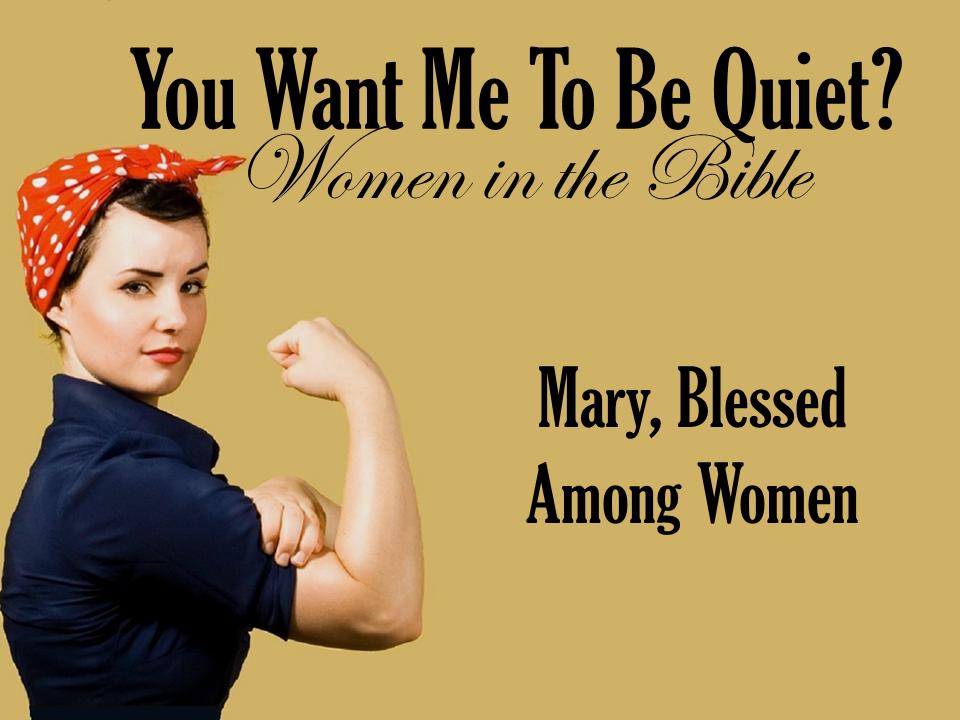
Mary, Blessed Among Women

Here is my sermon from Sunday.  The text was Luke 1:26-45:

There was an event that happened this week here in Albuquerque, that I thought was sort of appropriate as we celebrate Mother’s Day.  Some of you may have seen it on the news, and maybe some of you were even impacted by it, but somehow a dog made her way onto I-40, and decided, well maybe decided is the wrong word, but was forced to deliver her puppies on the side of the road, and so people were slowing down and causing a back-up and then someone called the city and animal control and the police showed up to make sure she and the puppies were safe, and everything worked out well, except for the fact that the police felt the need to issue a ticket to the dog for littering.


Today we continue in our series looking at the story of some of the women in the Bible, and if you missed any of those I encourage you to pick up a CD as you leave today, or listen to them on our Facebook or YouTube pages.  But as I was putting this series together I was asking my wife Linda, and the wonderful mother to my own children, about the order I should do things and to help me narrow down some of the stories.  As I listed off some of the women I thought we might cover today, I didn’t have Mary, the mother of Jesus on the list.  And Linda’s response was “It’s mother’s day, don’t you think you should do something about Mary?”  To which I foolishly responded something along the lines of “well I could, but I don’t have to.  I think there are other women I could discuss and give a message that also applied.”  And she said, “Its mother’s day, you should talk about Mary.”  And quickly realizing that I was not going to win this argument, and since I had already dismissed the idea that women should listen to their husbands, I did the prudent and smart thing and said “yes dear,” and so today we look at Mary, the mother of Jesus.

Now in the Protestant tradition, we haven’t really done a lot with Mary as a figure.  For those who grew up Roman Catholic or Orthodox, you heard a lot more about Mary and did a lot more with her than we Protestants do.  The primary reason for that is because at the time of the Protestant Reformation, Martin Luther sought to return to a scriptural basis for everything the church did.  By scripture alone became one of the rallying cries, and much of what the tradition holds about Mary is not found in scripture, and so her story was predominantly removed.  Now there were some other reasons as well, but that was one them, because in Mary is simply not talked about all that much in scripture.

Monday, May 4, 2015

The Canaanite Woman and Baltimore

Here is my sermon from Sunday.  The text was Matthew 15:21-28:

Jesus left that place and went away to the district of Tyre and Sidon. Just then a Canaanite woman from that region came out and started shouting, ‘Have mercy on me, Lord, Son of David; my daughter is tormented by a demon.’ But he did not answer her at all. And his disciples came and urged him, saying, ‘Send her away, for she keeps shouting after us.’ He answered, ‘I was sent only to the lost sheep of the house of Israel.’ But she came and knelt before him, saying, ‘Lord, help me.’ He answered, ‘It is not fair to take the children’s food and throw it to the dogs.’ She said, ‘Yes, Lord, yet even the dogs eat the crumbs that fall from their masters’ table.’ Then Jesus answered her, ‘Woman, great is your faith! Let it be done for you as you wish.’ And her daughter was healed instantly. (NRSV)

The theologian Karl Barth once said that preachers should work with the Bible in one hand and the newspaper in the other.  Now whether than still holds or not is up for debate, the biggest problem being that the number of people who actually read a newspaper is greatly reduced, and I am not one of them.  But as we were watched the events unfold in Baltimore this week, I couldn’t help but think of everything that I was seeing and hearing through the lens of the story of the Canaanite woman.

One of the commentators who lives in Baltimore said that what made him most sad was that the scars and destruction of the race riots from 1968 had not yet been overcome, and his fear was that in nearly 50 years this destruction would also still be present.  And my initial response was that the reasons for those riots in 1968 had not yet been overcome either, the wounds were still there, but I pray that will not be the case 50 years from now.  That we will begin to do something as a nation to change how we live together, but that requires us to look at ourselves, our culture and our country in profoundly different ways.  The Rev. Dr. George Hermanson says “social conventions develop over centuries and, by definition, are never explicitly discussed or agreed upon.  A crucial aspect of ‘convention’ is that it is unspoken and taken for granted.  Indeed, so taken for granted that we are by and large completely unaware of how much these codes are embedded in our most deeply held sense of what is true, right and just.”  It is that level of social convention that not only drives what we witnessed in Baltimore, but also drives the interaction between Jesus and the Canaanite woman.

Tuesday, April 28, 2015

Challenging God: Zelophehad's Daughters

Here is my sermon from Sunday.  The text was Numbers 27:1-11:

Many of you know that I am a number person.  Give me an excel spreadsheet, especially if it’s one I can make longer and more complex, and I am a happy person.  But if you had asked me when I began my ministerial career if there was one book in the Bible that I thought I might never preach from I would have probably said the book of Numbers, because these are not good numbers of excel spreadsheets, these numbers are census reports.  It’s not that there aren’t some good stories to be found in Numbers, but to get to them you have to wade through these lists of names. If you get bored in the genealogies found in other parts of scripture, you are going to fall asleep reading Numbers.  Now, I’m sure that there are some people who find these lists exciting, but I am not one of them, and so I rarely even think about Numbers, but then I came across this remarkable story of Zelophehad’s daughters.

At another church I served, someone asked me to preach about the proper role for women in the household; and while I knew what I thought I wanted to say, I didn’t really know how to approach it, and to be honest I was a little afraid to approach it, but then something remarkable happened.  Within a short period of time, two different people made mention of this story.  The first was someone with whom I went to high school who is now an atheist, although knowing something about the church he grew up in I can certainly understand how he ended up the way he did.  I don’t know how he heard about the story, but he found it exciting and definitely wondered why it had never been covered in his church growing up.  Then shortly thereafter someone else passed on info on a blog being done by someone who was reading the entire Bible and then blogging his thoughts about each story and what made her pass this blog on to others was when he got to this story.

So within less a week, two different people had commented on this rather remarkable story, which I had to have read it because it’s not just found here, but instead is actually mentioned five times in the Bible, although I didn’t even remember having every encountered it. So I thought that having this appear had to be more than just a coincidence and so I began learning more about Zelophehad and his remarkable daughters.

Tuesday, April 21, 2015

Women: Be Silent And Subservient

Here is my sermon from Sunday.  The text was 1 Timothy 2:8-15:

Today we continue looking at some of the difficult passages we find in scripture as they relate to women.  Last week we heard from 1 Corinthians that women should be silent in church, and I said that many scholars do not believe that passage was original to the letter, but instead think it came in as a margin notation based on the passage we just heard from 1 Timothy.  Just as a brief summary, scholars don’t think it’s original first because it doesn’t match what says about women, and their participation in church, in other parts of 1 Corinthians.  Second because it is not consistently found in the same places in the manuscripts we have giving some indication that the scribes were unsure where it properly belonged, which leads to the third point that the section of chapter 14 in which it is found is actually easier to read if it is removed because it interrupts what Paul is talking about otherwise.
So that leads us into today’s passage, of which there is no doubt is original to this letter.  Now where the doubt lies is whether Paul wrote 1 Timothy or not.  Although the letter says it is written by Paul, the vast majority of scholars do not believe it is written by Paul, and when I say the vast majority I’m talking close to 90.  Instead, this is a pseudepigraphical work, that is a work written by someone else in Paul’s name.  We have lots of different pseudepigraphical works as this was fairly common in the ancient world.  The main part of this is really a defense of Paul to say that I don’t think Paul ever said that women should be silent in church.  But even if Paul didn’t say it, it is still there, so how do we approach these passages?

The easiest thing to do would be to say that we are going to ignore it, pretend as if it doesn’t exist and go on to something else.  And the simple truth is we all do that all the time, we even do it with these passages.  So for example, the vast majority of churches that want to argue that women should be silent, and certainly should never be ordained, don’t require that women cover their heads when they come into church, as required by the rules Paul does stipulate in 1 Corinthians.  Nor do they stop women at the door of the church and tell them they can’t come in, because their hair is braided or they are wearing gold, pearls or expensive clothing.  So why is it that we ignore the rules that come right before choose not to ignore the one that comes after?  Is it because we often come to scripture looking for things we can use to justify our own biases while ignoring those that don’t?  And I’m not attacking a particular group, because all of us do exactly the same thing.  We all pick and choose what parts of scripture we want to follow, or force others to follow, and which we’re going to ignore or explain away to make our own point.

Monday, April 13, 2015

Women: No Talkin' In Church

Here is my sermon from Sunday.  The text was 1 Corinthians 14:33b-36:

Today is one of those days in which saying after the scripture reading is done, “this is the word of God,” leaves many people a little bit queasy.  This is one of the passages we find in the Bible with which many in the church don’t want to have to deal or even admit is there.  So, for example, this passage is not included in the lectionary, which are the recommended readings for each Sunday of the year.  But we don’t have to go very far in order to to find churches that still use this, and other passages to justify women not only leadership positions in the church but most especially ordination.

The girls and I were recently at the famous Irish restaurant McDonalds, and the guy at the next booth was talking on his phone with someone about the terrible decision that the church was considering at their next general church gathering, about the possibility of allowing women to be ordained.  And to this gentleman not only was this an abomination, but it was the work of Lucifer himself to try and bring down the church.  Now based on what he was saying I was able to find out that he was a member of the 7th day Adventists, and the great irony is that the 7th day Adventists was cofounded by a woman.  So although we don’t talk about these passages much, if at all, in the mainline churches, we ignore them and others like them at our own peril, and at the peril of the greater church.

Now today’s sermon is going to be a little different than what I normally try to do which is to try and make the scripture applicable, so that we might learn something from it and live that out in our lives.  I know that I do not always accomplish that goal, but that is what I at least try to do most of the time.  I’m not going to do that today, so if you want to hear some good illustrations, be uplifted and look at how to apply the scripture to your life, please come back next week, because today I am going to try and unpack this passage, to provide some background and some perspective on this passage, and then next week we’ll look at possible interpretations and how we can learn from these passages.  A good place to start is with the simple understand that there are some things in scripture with which we are going to disagree, and to recognize the lens through which we read scripture has as much to do with our understanding of scripture as the words on the page do.  So, for example, if we were to read the passages found in scripture that relate to slavery, we read them very differently today than we did just two hundred years ago. Our understanding and interpretation of those passages, and the lens through which we read them, has changed radically in the last few centuries.

Tuesday, October 12, 2010

Abhorrent Behavior

I'm sure this will come as no surprise to most people, but most professional athletes are extreme narcissists. I might even venture a claim that every professional athlete has narcissistic tendencies that are greater than the general public. Most of this is not their fault however because they have been trained to be narcissists by nearly everyone in their lives from the earliest days that they showed skills greater than the normal youth athlete.

In addition, for many of these athletes there have not really ever been serious consequences for their negative behavior. Instead they have been coddled and protected for nearly their entire lives. When they have done things wrong people have made excuses or looked the other way. It is little wonder that so many athletes at college and in the pros get into trouble, because they never expect to get into trouble. Even when they have it happen once they certainly don't expect it to happen again.

One of the areas that again and again gets athletes in trouble is women. They have little experience being turned down and even less being rebuked, and so when they don't get things their own way they act out in negative ways. We need look no further than Ben Rothlisberger's problems, or those that Brett Favre is now being accused of.

Favre is the perfect example of narcissism gone wrong. Every year he is able to keep everyone begging at his door to come back and play and he is able to stay out as long as he wants to with no consequences. Instead everyone fawns all over him and are so grateful that he deigns to stoop to their level to even talk to them let alone play for them. He is coddled and protected by everyone from the front office to the coaches and most especially the media. It is pretty rare to hear any criticism of Favre's behavior over the past few years. The two who stand out for consistently calling him out are Michael Wilbon and Gregg Easterbrook. Unfortunately they are only two small voices in a much larger cacophony of adulation.

So it would not surprise me at all if Favre actually did what he is being accused of. At this point all there are is accusations and it is still not clear if the woman who supposedly received the inappropriate texts and images will even cooperate. And here is the true tragedy of the situation: If she does cooperate you can be pretty sure that any career she might have wanted to have in professional sports would be over. It might already be over for even having this information brought to light.

Many people are now saying that she must not have been offended by this information at the time because she didn't complain about it then. That is such a false argument on its face, that it shows they don't understand the seriousness of the allegations or the situation. Again, if she, as an employee of the Jets, had brought allegations against their newly acquired future hall of fame quarterback who was finally going to deliver the Jets their long awaited Super Bowl trophy, what do you think would have happened to her?

I'm pretty sure she would have kissed her job good bye. She would probably have been ridiculed and attacked on every front and by nearly everyone, including her employer. That is what sports teams usually do, although we are seeing a positive change on this, and quarterbacks are protected even more than others. This is not some third and long pulling guard, this is Brett Frickin Favre. I'm sure she feared for her job and her reputation, and I'm sure she still does.

It does not surprise me that she didn't say anything, and, if the allegations are true, it wouldn't surprise me if there are others out there who have experienced the same behavior from Favre. These are seldom isolated incidents. Instead they are patterns of behavior that have never been corrected, but instead tolerated, and this is true for more than just athletes.

We need to wake up to the enabling behaviors that we as a society give to professional athletes (and politicians and musicians and actors, and... and... and...), and realize that in order for their abhorrent behavior stop we have to stand up and stop it. And this must happen much earlier than when they cash their first paycheck. It needs to happen in youth sports, high school and in college, and we need to hold the adults in their lives accountable as well.

When Urban Meyer at the University of Florida can get off without even a rebuke for the behavior of his players (19 players have been charged with crimes since 2005. Many of them have been charged multiple times) then there is no incentive for him to step in and do anything, nor is their any incentive not to recruit athletes with troublesome pasts. I believe everyone deserves at least a second chance, and sometimes more, but unless someone is willing to say that this behavior will not be tolerated and there are consequences then the behavior will never change.

In addition, we are well past the point where we can just say "it's just boys being boys." Sexual harassment not only shouldn't be tolerated, but it is illegal. Although this is not being charged as a sexual harassment case, that is certainly how it appears, because through his alleged actions Favre had the potential of creating a hostile work environment. The simple fact that the alleged victim probably did not feel safe in bringing any charges against him, shows the power differential that existed and allowed this behavior to exist.

If Favre is cleared of everything, this does not change his overall narcissistic behavior nor does it change the reality of the situation as it currently exists for most athletes. It would be just as easy to replace Favre's name with any other of thousands of athletes (and politicians, etc.) who exhibit the same abhorrent behavior. It is past time for us as a society to stand up and say that this will not be tolerated, because until we do, nothing will change.

Until we say that we will no longer buy the merchandise or attend any game for any team or league that tolerates this, then it won't change. Until we say that we will no longer vote for any politician, no matter how much we like their policies, who exhibit this type of behavior then it will never stop. And until we say that we will no longer pay to see any musician or actor who exhibits this type of behavior it will never stop.

Until we stand up and hold people accountable for their actions and say we are not going to tolerate it any more, then we are just as guilty as they are.